AI does the work. You stay in charge.
Most tools make you choose: keep AI out of your notes, or let it loose and hope. Verse is built around a loop in between, so AI can do real work in your notes and you never lose track of what it touched.
One button. Any AI.
Press one button, or one keyboard shortcut, and the page you are on is packaged as clean context and on its way to Claude, ChatGPT, Gemini or whatever you use. No copy and paste, no export, no reformatting.
Launch plan
Before launch
What to send
Where to
AI that cannot quietly ruin your notes.
The fear with AI in your notes is the silent rewrite you find three weeks later. Verse treats AI as an editor you supervise: it is named, it is checkpointed, it is reviewable, and it can be fenced off. Supervising it is meant to take seconds, not attention.
Launch plan
History
Choose how much trust each AI gets
Set it per AI and per folder. Turn it up as an AI earns it.
Why this works in Verse
Because your notes are plain files, a checkpoint is a copy of files and an activity log is a file. Nothing in this lane depends on a server, so it works fully offline and on a folder that never leaves your Mac.
It also means supervision does not depend on the AI behaving. Verse enforces the fence and records the change itself, whichever AI is on the other end.
Notes that never leave your device.
Verse has no cloud to trust. It opens a folder on your own machine. No account, no server, no analytics on your writing. If you never connect an AI and never turn on sync, nothing you write goes anywhere.
A real editor for the human half.
Pages are made of blocks you can turn into anything and place on a magnetic grid. Drag a block and the rest of the page makes room. No widths to fiddle with, no layout that breaks.
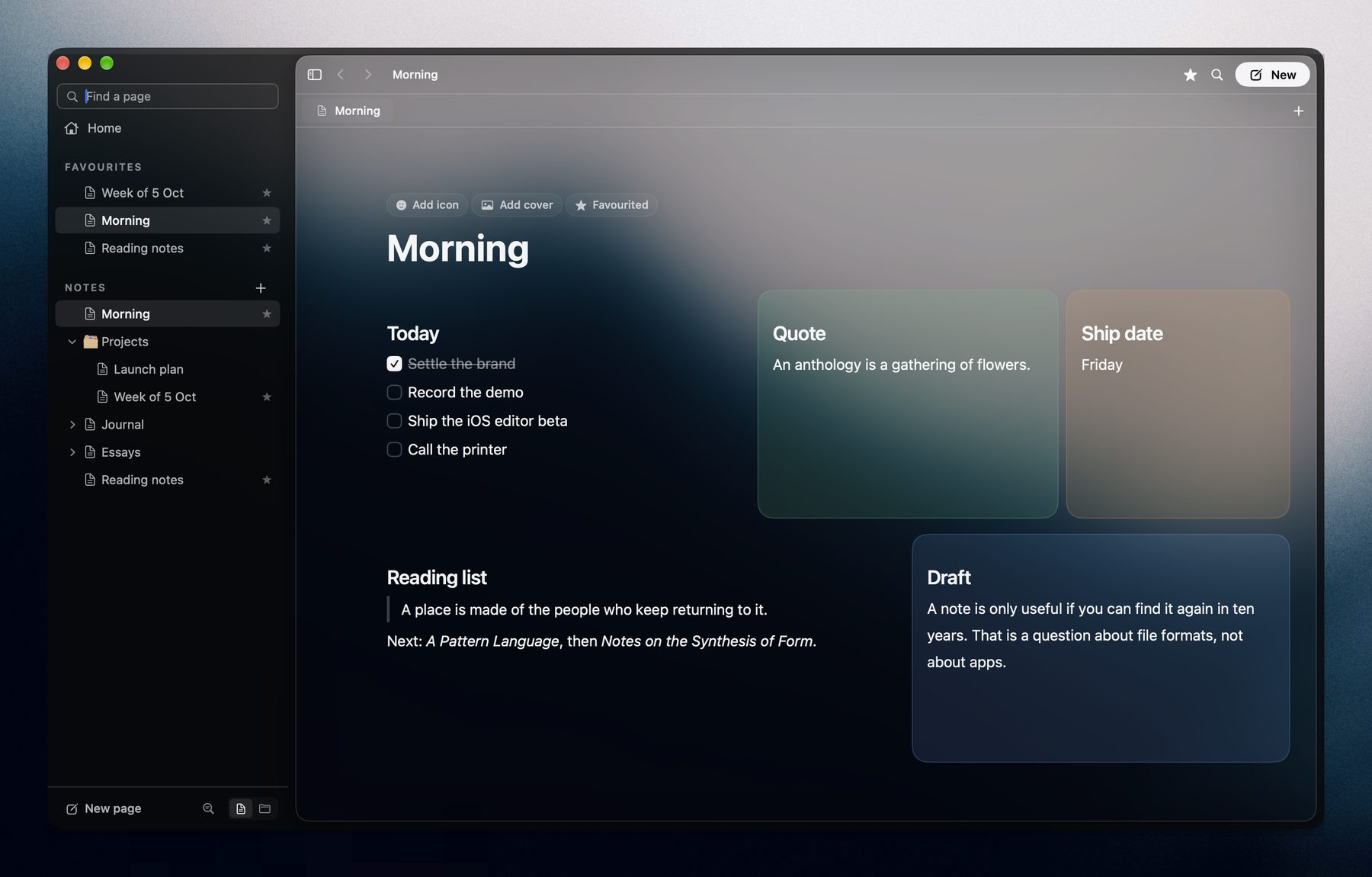
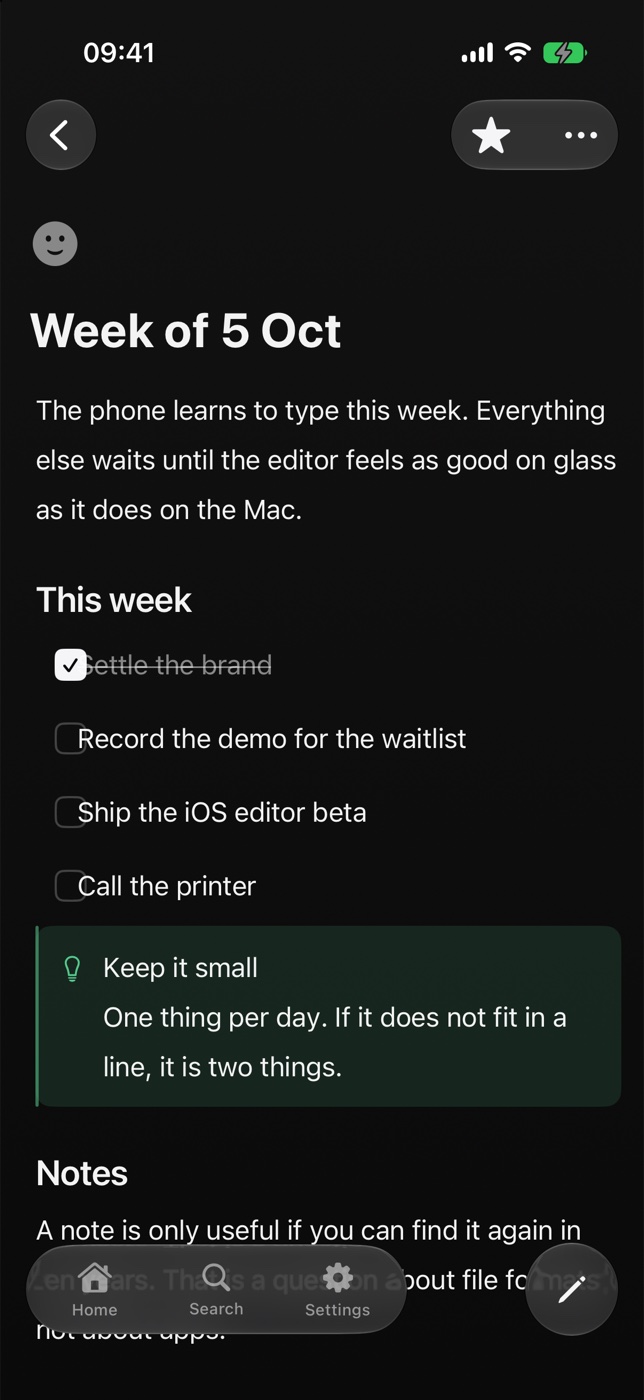
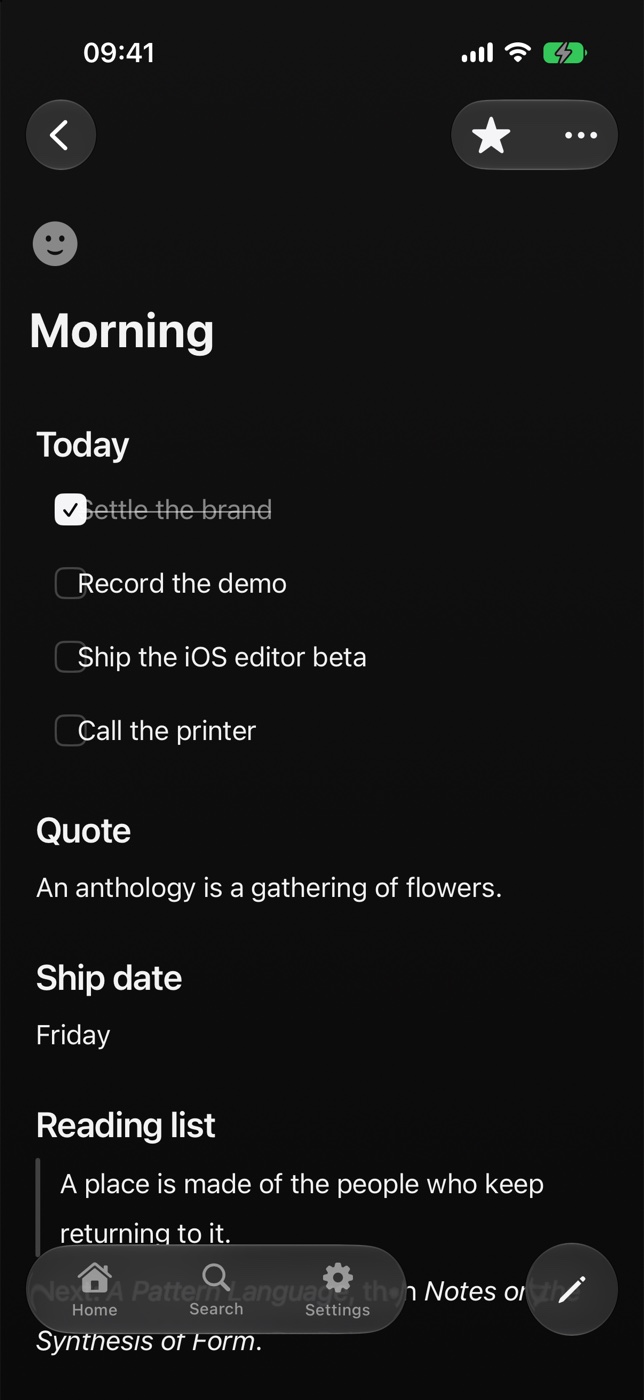
A real Verse page. The layout is saved in the Markdown file, and on a phone the same blocks read top to bottom.
The page is the file.
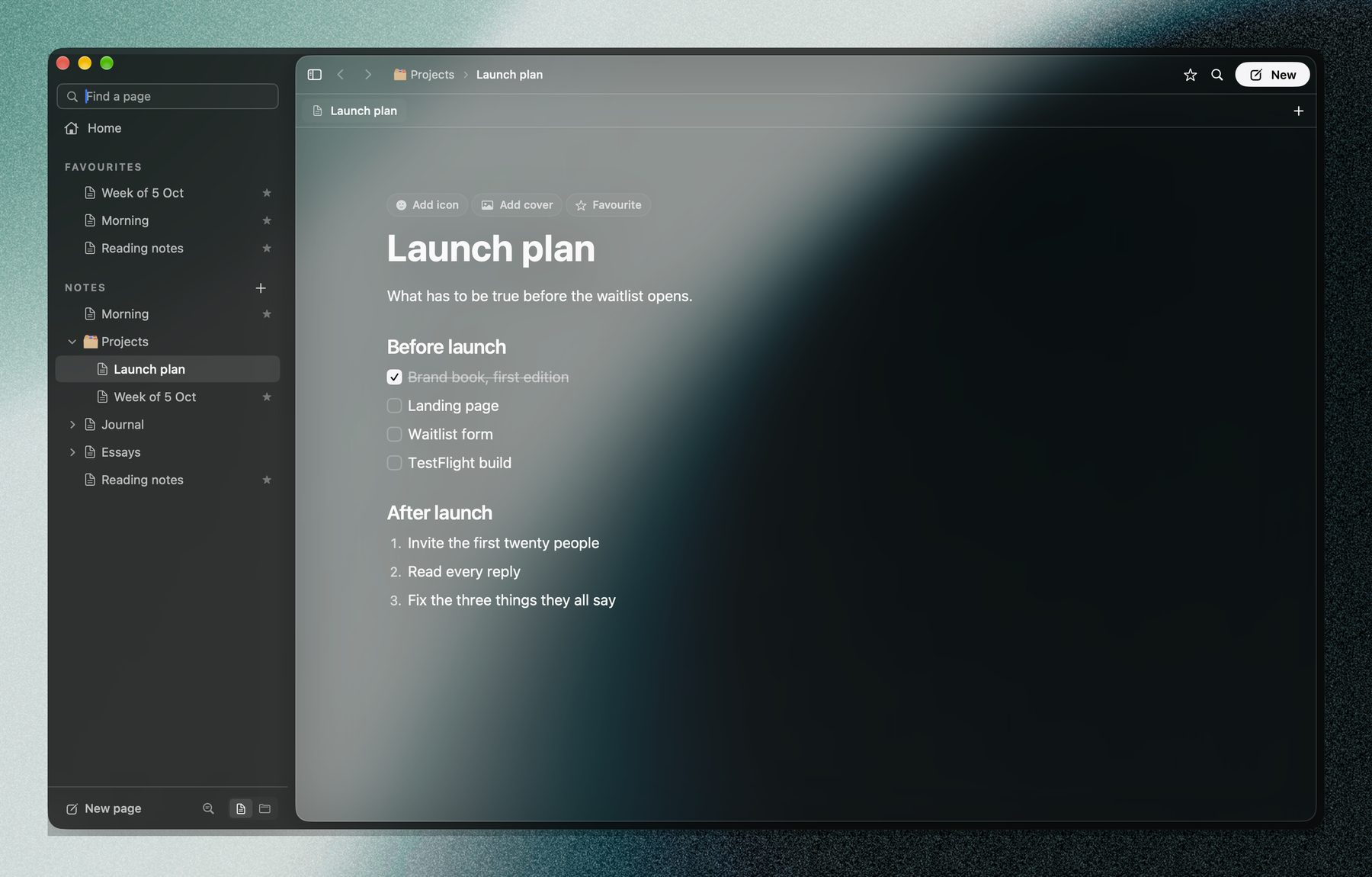
Every Verse page is a Markdown file in a folder you choose. What you see on the left is exactly what is on disk on the right. Open it in Finder, in another editor, in ten years. Nothing is locked in.
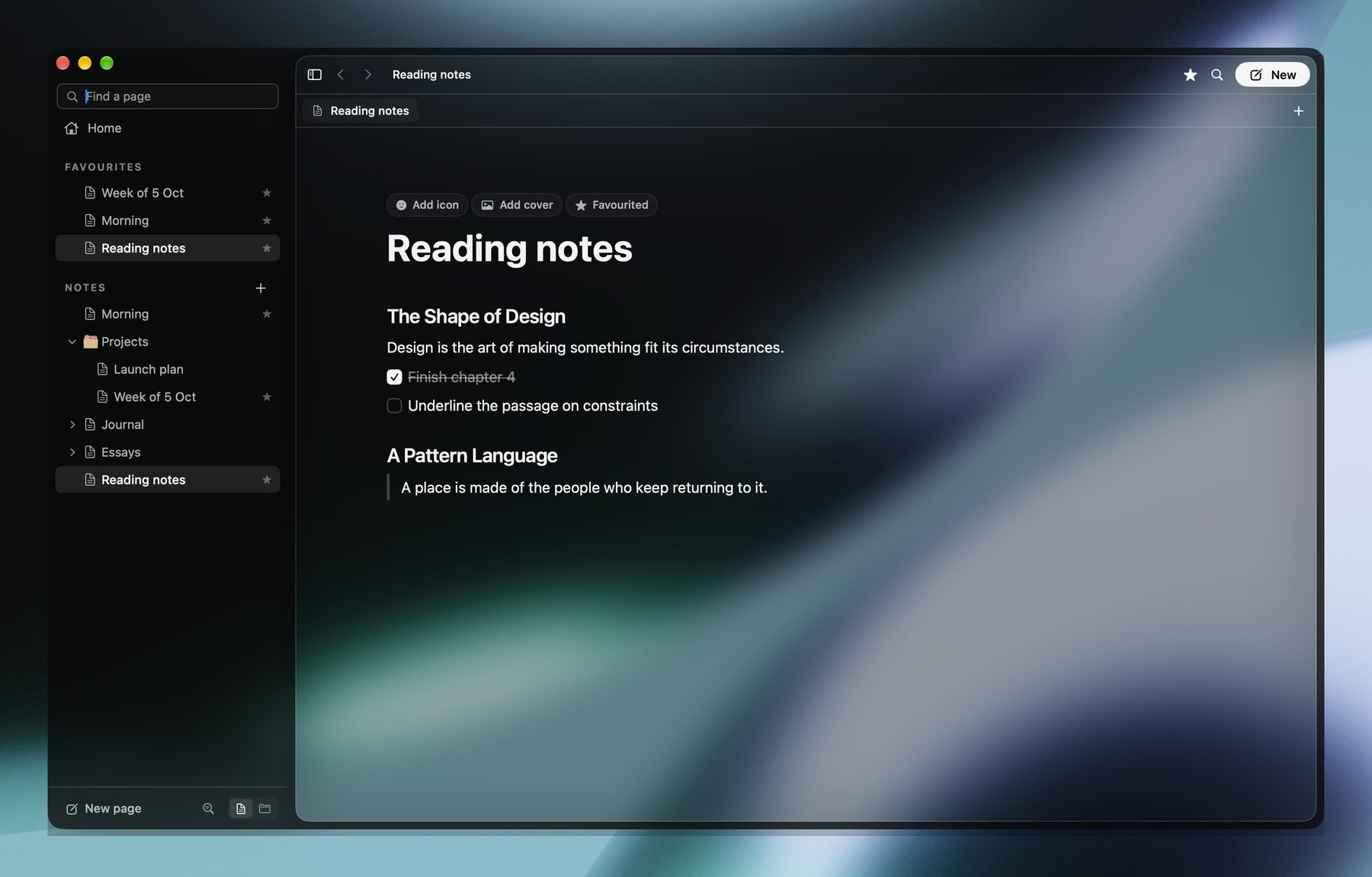
One place every AI can write.
Because every page is a file, an AI edits Verse with the tools it already has, while the app is open, and you watch each change land on the page. Claude Code works today. Connections for Claude, ChatGPT and other assistants over MCP, and a bridge to tools like Notion, are on the way.
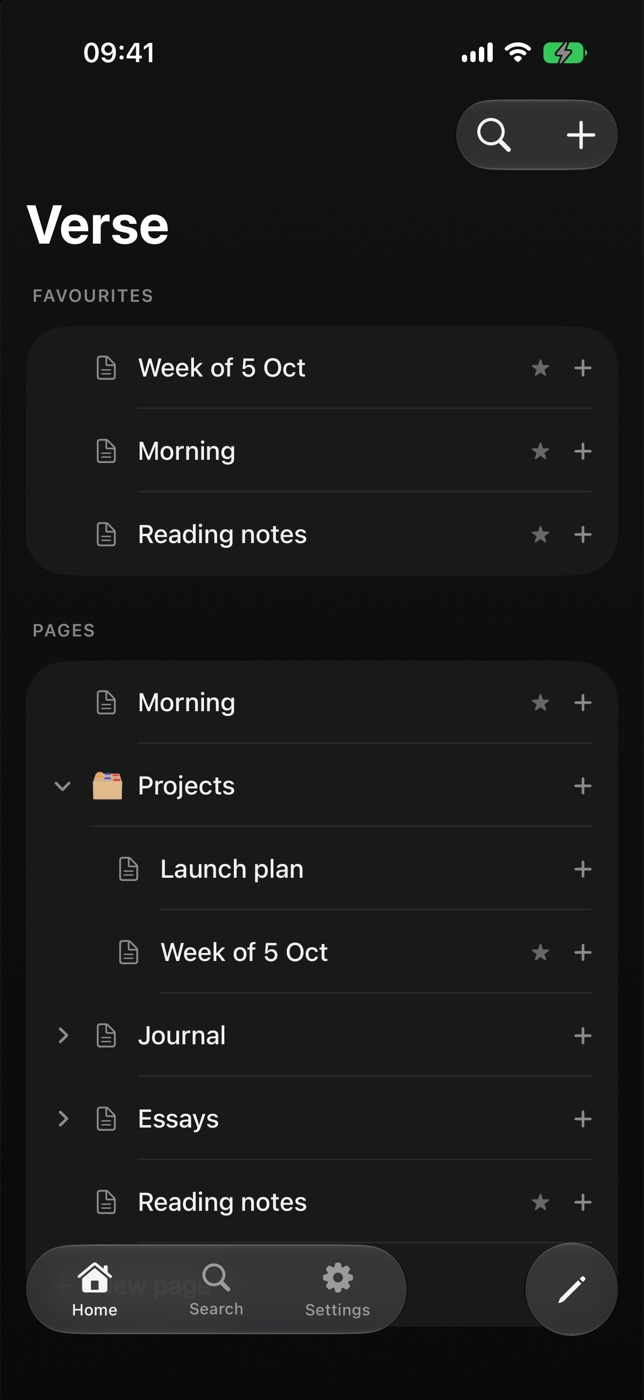
The same folder, in your pocket.
The iPhone app opens the same folder in your iCloud Drive, so the page you wrote on the Mac is already there. Read it, tick a box, jot a line. No sync service, no account.
Not a Notion replacement. A different job.
Notion is a great place for a team to work in the cloud. Verse is the place your notes and your AI live on your own device. Use it beside Notion or Obsidian, and let Verse be where AI writes and you stay in control.
| Verse | Notion | Obsidian | Open sourceAppFlowy, AFFiNE, Logseq | |
|---|---|---|---|---|
| Your notes are plain files | Markdown in your folder | In Notion's cloudExport to get them out | Markdown in your vault | Depends on the toolSome use their own database or format |
| Block editor | Blocks, slash menu, toggles, databases | The best in class | Text editor with plugins | Blocks, rougher edges |
| Layout you can arrange | Magnetic grid, saved in the file | Columns | Linear pagesCanvas is a separate file type | Varies |
| Native Mac, iPhone, iPad | SwiftUI and AppKit | Web app in a shell | Electron and a web view | Electron, Flutter or web |
| Nothing leaves your device | Local folder, no account | Cloud first | Local vault | Self-host or their cloud |
| Claude edits it directly | Same files, live, marked as Claude's | Through Notion's API and its own AI | Files yes, live view through plugins | Through each tool's API |
| Sync | Your iCloud Drive, nothing else | Notion's servers | Paid Sync, or set it up yourself | Self-host or their cloud |
| Works offline | Always, it's a folder | Partly | Always | Mostly |
| If the app disappears | You still have every file | You have an export | You still have every file | You have the code |